

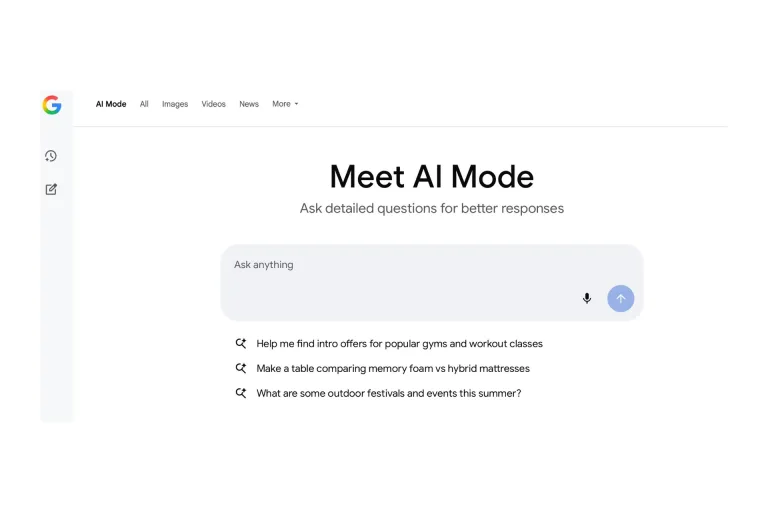
Google AI Mode, which shares a lot of similarities with ChatGPT, is now available to everyone in the U.S.
Essentially, Google sees the advantages of ChatGPT over its own product and realizes that it can either risk some of its ad revenue from Google Search ($175 billion in 2023!!!) or die a slow death.
While the only constant is change (especially in the world of SEO and in the last 3 years more than ever!) I do feel like we’ve reached a point where the pace of change is going to slow down – so I’ve decided to do a deep dive into what AI Mode is and what it means for your SEO strategy in the coming years.
What exactly is Google AI Mode?
It’s a tab in Google Search that enables U.S. users to get AI-generated answers (powered by Google’s Gemini model) and facilitates follow-up questions.
When someone types in a question, Google pulls information from multiple sources, and creates a single, cohesive answer. These summaries include links to the sources.
As you can see in the two screenshots that follow, it is very easy for Google users to switch from traditional search to AI Mode.


Now, people are encouraged to ask follow-up questions directly in the same thread, turning Search into more of an ongoing conversation.

How AI Mode changes Search
The biggest difference between what we previously had (AI overviews layered on traditional search) and AI Mode is that users are now more encouraged to stay on Google’s platform if they want more information on a topic instead of navigating to an external website.
Edit: after publishing this article, I watched Lex Fridman’s June 2025 interview with Sundar Pichai (the CEO of Google and Alphabet). Pichai said, “AI mode will offer you the bleeding edge experience, but things that work will keep overflowing to AI overviews and the main experience.”
How to track clicks from AI Mode
Clicks from AI Mode (as of this writing) are not showing in Google Search Console & they are being attributed to “direct” traffic in Google Analytics.
Aleyda Solís pointed to this issue on LinkedIn. John Mueller, who coordinates Google Search Relations efforts, replied to her post with the following:
“This seems unexpected, thanks for also flagging, Aleyda. I saw this somewhere else and had already sent it to the team to check, but haven’t heard back. Fingers crossed. (Update: it’s being tracked as a bug).”
I expect this to be resolved soon.
Should companies still invest in SEO?
The million-dollar question…
Yes, but not every company and the ones that do invest in SEO should broadly optimize to be included in answers that drive revenue for their company – across various platforms (so not only Google, but also ChatGPT, Perplexity, etc.)
Also, we’re going to have to change how we track returns from SEO investments.
A study by Siege Media looked at search console data for 28 of their B2B clients and found that whole site traffic was down 2% for the last three months (starting May 19th, 2025) compared to the previous three months, but homepage traffic was up 15% over the same period.
This makes sense: brands are surfaced for queries – in Google and AI tools – so even though you get fewer clicks to your blog, when a potential customer is near a buying decision, they recall your brand and perform a branded search.
Homepage traffic converts better than sitewide traffic, so a decrease in sitewide traffic but an increase in homepage traffic may be net-positive.
How to decide if SEO still makes sense
It never made sense for every company to invest in SEO – and now it makes sense for a lower percentage of companies than before.
SEO has always had an uncertain and delayed payoff, which means it has only ever made sense to embark on an SEO campaign if you believe you will get a large return on investment.
As a thought exercise, it doesn’t make sense to invest $50,000 into SEO in your first year if you see a 60% chance of $75,000 in lifetime value and a 40% chance of $25,000 of lifetime value from those first-year efforts.
There’s simply not enough “margin of safety” – to repurpose an investing concept popularized by Warren Buffett. Not to mention, a dollar today is worth more than a dollar tomorrow…
It’s impossible to make SEO ROI projections with anything close to this level of accuracy. But the point is, if you see small upside, SEO is probably not a good investment.
But here’s the deal:
If you see ~5-10x+ potential returns, and SEO is accounting for 10% of your marketing budget, it makes a lot more sense.
Ask yourself:
- Is our product among the best in our industry?
- Is the SEO competition low?
If you answer “yes” to both questions, SEO is more likely to be a good use of resources.
Where is Search heading?
At its core, Google has always been an answer engine. The 10 blue links stuck around for years – not just because they worked well, but because there were no real threats and they made Google a boatload – or maybe more like 100 boatloads – of ad dollars. But now, ChatGPT has forced Google to risk their ad revenue.
SEO has always been about getting in front of potential customers. The goal wasn’t traffic for its own sake, but for the conversions that traffic could lead to.
For example…
The university student who made a pure informational query, went to a page on your B2B site, read one sentence and bounced – they never moved the needle.
The key is optimizing for the answers that matter. For an e-commerce shop that sells aquariums, getting surfaced for “how long does [insert type of aquarium] plant last?” should not be a top priority – though it might still be worth writing (more on that in a bit). But showing up for “best fish tank for beginners” is important to the business, because it aligns with purchase intent.
Do the same old SEO formulas still apply?
Short answer: the fundamentals are still the same, but the execution is evolving.
If you’re investing in SEO, it’s still content + links. But the strategy around both is changing.
Be the same & be different in the AI era
Google still rewards SEO-optimization, which you can argue equates to being the same as everyone else, but doing it bigger/better. LLMs, on the other hand, seem more likely to reward you for being different IF it means legitimately being the best.
Luckily, you can be the same and be different – it’s not an either/or decision.
SEO-optimize your website AND make your USPs crystal clear.
The top-of-funnel content debate
I want to address the value of top-of-funnel (ToFu) content (for example, “what is” blog posts) going forward.
Many argue that you shouldn’t write this type of content anymore because:
- AI can answer basic questions directly
- Users prefer quick answers without clicking through
- Traffic from informational queries has a low conversion rate
Good points, but I still think that ToFu content is a good investment for some companies because of the following reasons:
- Value beyond direct clicks and conversions: ToFu content can help boost money pages – building topical authority and attracting backlinks.
- Broadly applicable: SEO content can support broader marketing campaigns unrelated to SEO, such as email marketing campaigns.
- Higher value clicks: now, the traffic you get is more qualified. In the AI age, people who just want a one-sentence answer – and will never buy from you – won’t contribute as much to your clicks.
- Production cost: content is cheaper than ever to produce; if it drives fewer clicks, but it’s cheaper to produce than it used to be… and those clicks are worth more than before… then the math can still work.
- Evergreen value: for many companies, ToFu content is evergreen, so your one-time investments can pay off for many years.
Links are still necessary
Links will continue to be necessary – I don’t see that changing anytime soon. In a world where content is increasingly commoditized, quality links (i.e. votes of confidence from authoritative sources) serve as a differentiator.
I don’t see AI Mode having much of an impact on link building strategies.
Moving forward
Here are nine key points to remember moving forward:
- Focus on answer optimization: position your company to be the definitive answer to high-value queries in your space – on every platform.
- Invest in topical authority: build comprehensive expertise in your domain rather than chasing individual keywords.
- Quality over quantity: with AI handling basic queries, your content needs to provide genuine value that AI can’t replicate.
- Look at branded searches: if they are increasing, your SEO efforts may be indirectly paying off.
- Link building remains important: focus on earning high-quality backlinks.
- Multi-purpose content strategy: create content that serves multiple functions – SEO, email campaigns, LinkedIn, etc.
- Have a “margin of safety”: don’t invest in SEO if there’s not much upside.
- Track to the best of your ability: yes, it’s hard to 100% quantify your SEO efforts, but that doesn’t mean you shouldn’t track them at all.
- Focus on leads: if clicks are down, but you’re getting more quality leads from your website, you might want to continue investing in SEO.
SERP Builders is an expert-driven, AI-enhanced SEO & Content Marketing agency focused on future-proof visibility – on Google and across AI-driven search experiences.
Learn more about our SEO and content services, or reach out for a tailored strategy that fits your site’s needs.
